Program 4 - Alzheimer's Disease
Overview
Alzheimer’s disease (AD) is a progressive neurodegenerative disorder marked by cognitive decline, memory loss, impaired reasoning, and behavioral disturbances. It is the most common cause of dementia worldwide and currently affects more than 50 million individuals globally. As populations age, this number is expected to increase substantially, placing growing pressure on families, caregivers, and healthcare systems.¹˒²
Current medical therapies—including acetylcholinesterase inhibitors, NMDA receptor antagonists, and recently developed monoclonal antibodies—primarily focus on symptom management. While these treatments may provide modest cognitive benefits, they do not adequately address several fundamental biological drivers of the disease, including mitochondrial dysfunction, oxidative stress, neuroinflammation, and pathological protein aggregation.³
Biophoton Quantum Medicine (BQM) represents a novel, non-invasive therapeutic approach that aims to target these underlying mechanisms. Through controlled photonic stimulation, BQM seeks to restore neuronal energy metabolism, reduce inflammatory activity, enhance neuroplasticity, and potentially influence amyloid and tau protein metabolism. These combined effects suggest a promising complementary strategy for managing Alzheimer’s disease.⁴–⁷
Pathophysiology of Alzheimer’s Disease
Alzheimer’s disease arises from multiple interacting biological processes that progressively damage neurons and disrupt neural communication.
Proteinopathies
The accumulation of extracellular amyloid-beta plaques and intracellular hyperphosphorylated tau tangles interferes with synaptic communication and eventually leads to neuronal death.⁸
Mitochondrial Dysfunction
Neurons in Alzheimer’s disease show reduced activity of cytochrome c oxidase (CCO) and impaired oxidative phosphorylation, resulting in decreased ATP production and compromised cellular energy metabolism.⁹˒¹⁰
Oxidative Stress
Excessive production of reactive oxygen species (ROS) damages cellular DNA, proteins, and lipids, accelerating neuronal degeneration.¹¹
Neuroinflammation
Chronic activation of microglia leads to sustained release of inflammatory cytokines such as IL-1β, TNF-α, and IL-6, contributing to neuronal injury.¹²
Cerebrovascular Dysfunction
Reduced cerebral blood flow and microvascular abnormalities limit the delivery of oxygen and glucose to the brain, further impairing neuronal function.¹³
How Biophoton Quantum Medicine Supports Alzheimer’s Management
Biophoton Quantum Medicine addresses several of the key biological processes involved in Alzheimer’s disease.
Enhancing Mitochondrial Function
Biophotons interact with mitochondrial cytochrome c oxidase, improving electron transport chain efficiency and restoring ATP production. This enhancement in cellular bioenergetics supports synaptic activity and cognitive performance.⁴˒⁹˒¹⁰
Reducing Oxidative Stress
BQM can trigger a controlled ROS signaling response that activates antioxidant gene pathways, particularly the NRF2 pathway. This increases the production of antioxidant enzymes such as superoxide dismutase (SOD), catalase, and glutathione, helping to protect neurons from oxidative injury.¹¹˒¹⁴
Modulating Neuroinflammation
Biophoton exposure may suppress NF-κB signaling and reduce the production of inflammatory cytokines, thereby limiting excessive microglial activation and promoting a neuroprotective environment.¹²˒¹⁵
Promoting Neurogenesis and Synaptic Plasticity
Photobiomodulation stimulates brain-derived neurotrophic factor (BDNF) expression and promotes synaptic formation and hippocampal neurogenesis. These processes are essential for learning, memory formation, and cognitive resilience.¹⁶˒¹⁷
Improving Cerebral Blood Flow
Biophoton stimulation promotes vasodilation through nitric oxide signaling and improves microvascular circulation. This enhances oxygen and nutrient delivery to vulnerable brain regions.¹³˒¹⁸
Regulating Amyloid and Tau Pathways
Emerging research suggests photobiomodulation may support glymphatic clearance of amyloid-beta and influence tau phosphorylation, potentially reducing pathological protein accumulation.¹⁹–²¹
Clinical Observations and Case Reports
Early studies and observational reports suggest several potential benefits of biophoton therapy for individuals with Alzheimer’s disease.
Cognitive Improvements
Small clinical studies have reported improvements in memory, attention, and cognitive performance following transcranial photobiomodulation treatments.²²–²⁴
Mood and Behavioral Benefits
Patients undergoing therapy have shown reductions in agitation, anxiety, and depressive symptoms, improving overall quality of life.²³
Biological Markers
Experimental models and pilot studies have demonstrated reductions in amyloid burden, increased mitochondrial biogenesis, and decreased inflammatory cytokines.¹⁶˒¹⁹˒²⁵
Daily Functioning
Caregivers frequently report improvements in independence during daily activities when patients receive consistent BQM therapy.²⁴
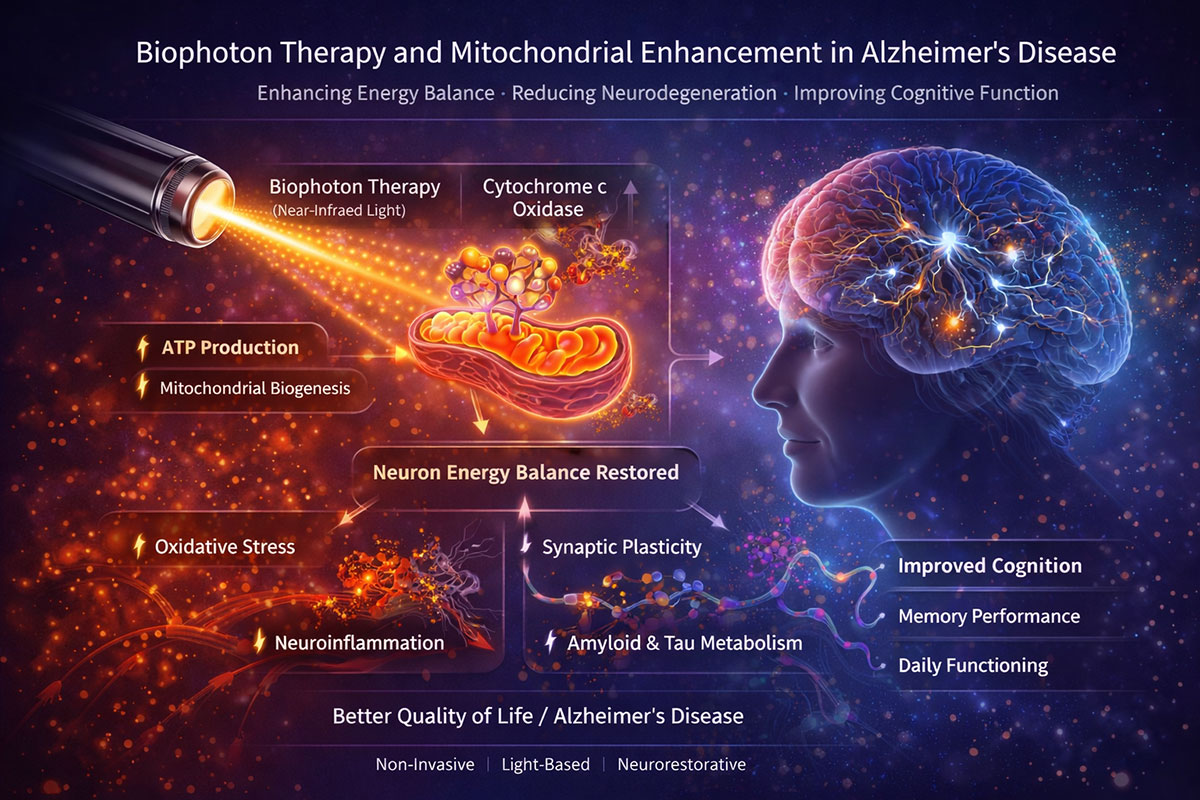
Figure AD. Biophoton Quantum Medicine in Alzheimer’s Disease. Biophotons absorbed by mitochondrial cytochrome c oxidase enhance ATP production and stimulate mitochondrial biogenesis, restoring neuronal energy balance. These upstream effects lead to reduced oxidative stress, decreased neuroinflammation, improved synaptic plasticity, and modulation of amyloid and tau metabolism. The combined result may include improved cognition, memory performance, and daily functioning in individuals with Alzheimer’s disease.
Recent Multimodal Evidence
Recent multimodal studies conducted by our research group provide additional support for the therapeutic potential of BQM:
• Cognitive restoration and improved neuronal energy metabolism were observed in Alzheimer’s patients exposed to biophoton therapy.²⁸
• Quantitative EEG analysis demonstrated improvements in neural coherence and spectral power, indicating functional brain recovery.²⁹
• Improved blood fluidity and systemic circulation were observed in early-stage Alzheimer’s disease.³⁰
These findings strengthen the clinical relevance of BQM and highlight its safety and potential for functional restoration.
Applications in Alzheimer’s Care
Biophoton Quantum Medicine may play several roles in Alzheimer’s disease management.
Early Intervention
BQM may support cognitive function in individuals with mild cognitive impairment (MCI), potentially delaying disease progression.²²
Slowing Disease Progression
By addressing mitochondrial dysfunction, oxidative stress, and neuroinflammation, BQM may help slow neurodegenerative processes.⁴˒¹¹˒¹²
Conclusion
Alzheimer’s disease remains one of the most challenging neurodegenerative disorders with limited effective therapies. By targeting key mechanisms—including mitochondrial dysfunction, oxidative stress, inflammation, vascular impairment, and synaptic decline, Biophoton Quantum Medicine offers a rational and mechanism-based therapeutic strategy.
With growing preclinical and clinical evidence, including recent multimodal studies demonstrating improvements in cognition, electrophysiological activity, and circulation, BQM may emerge as a valuable complementary approach in Alzheimer’s care, with the potential to enhance quality of life and support long-term neurological health.
References
Updates are presented for informational purposes
and reflect ongoing scientific evaluation.
1. Dauer W, Przedborski S. Parkinson’s disease: mechanisms and models. Neuron. 2003;39(6):889–909.
2. Spillantini MG, Schmidt ML, Lee VM, Trojanowski JQ, Jakes R, Goedert M. Alpha-synuclein in Lewy bodies. Nature. 1997;388(6645):839–840.
3. Schapira AH. Mitochondrial dysfunction in Parkinson’s disease. Cell Death Differ. 2007;14(7):1261–1266.
4. Connolly BS, Lang AE. Pharmacological treatment of Parkinson disease: a review. JAMA. 2014;311(16):1670–1683.
5. Benabid AL, Chabardes S, Mitrofanis J, Pollak P. Deep brain stimulation of the subthalamic nucleus for the treatment of Parkinson’s disease. Lancet Neurol. 2009;8(1):67–81.
6. Hamblin MR. Photobiomodulation for neurodegenerative diseases. BMC Neurol. 2019;19(1):1–19.
7. Salehpour F, Cassano P, Rouhi N, Hamblin MR. Near-infrared photobiomodulation in depression and Parkinson’s disease. Front Neurosci. 2018;12:119.
8. Johnstone DM, Moro C, Stone J, Benabid AL, Mitrofanis J. Near-infrared light therapy in Alzheimer’s and Parkinson’s disease. Front Neurosci. 2016;9:500.
9. Moro C, Torres N, Arvanitakis Z, et al. Photobiomodulation therapy in Parkinson’s disease. Parkinsonism Relat Disord. 2020;73:85–93.
10. Silva DF, Esteves AR, Oliveira CR, Cardoso SM. Mitochondria in neurodegeneration. Curr Alzheimer Res. 2011;8(5):563–572.
11. Chung H, Dai T, Sharma SK, et al. The mechanisms of low-level light therapy. Ann Biomed Eng. 2012;40(2):516–533.
12. Naeser MA, Zafonte R, Krengel MH, et al. Cognitive improvements after near-infrared light treatments. J Neurotrauma. 2014;31(11):1008–1017.
13. Hamilton C, Mitrofanis J, et al. Photobiomodulation and dopaminergic regulation. Neurosci Lett. 2018;684:200–207.
14. Henderson TA, Morries LD. Near-infrared photonic energy penetration into the brain. Neuropsychiatr Dis Treat. 2015;11:2199–2210.
15. Liu JZ, Smotrys M, Robinson SD, Liu S, Gu HY. Therapeutic Benefits of Biophoton Therapy in Parkinson’s Disease. J Neurol Res Rev Rep. 2025;7(6):1–6.
16. Liu JZ, Smotrys MA, Robinson SD, Yu HX, Liu SX, Liu DR, Gu HY. Quantitative EEG Evidence of Functional Brain Recovery in Parkinson’s Disease Following Biophoton Therapy. J Neurol Res Rev Rep. 2025;7(7):14–20.
17. Hu Y, Gu HY, Liu JZ. Hemorheological restoration in Parkinson’s disease following biophoton therapy. Journal of Neurology Research Reviews & Reports. 2025.
Disclaimer: BrainHealing.com provides informational content regarding investigational neurological treatment programs and related scientific development activities. The information presented on this website is intended for investors, researchers, healthcare professionals, and potential strategic partners.
The investigational programs described on this website are under evaluation and are not offered for commercial sale. Statements on this website should not be interpreted as claims of regulatory approval, medical efficacy, or therapeutic effectiveness unless explicitly stated.
Nothing on this website constitutes medical advice. Individuals should consult qualified healthcare professionals regarding medical conditions or treatment decisions.

Copyright © 2026 BrainHealing Inc.